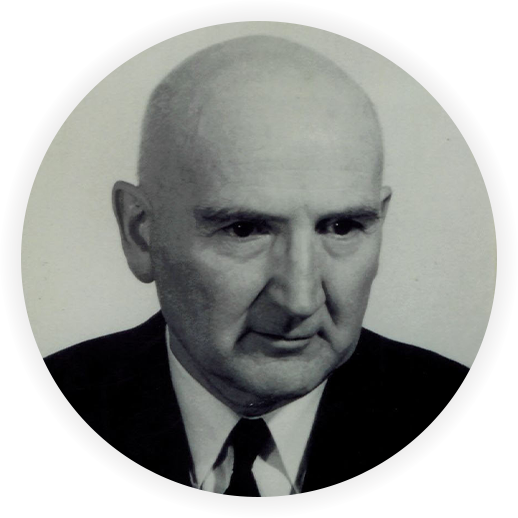
Jean Reyre, empire-builder (1899-1989)

From 1948 to 1966, Jean Reyre served as Managing Director of the Banque de Paris et des Pays-Bas, transforming the bank into a key player in France’s industrial rebirth and restoring its international stature.
In the footsteps of Horace Finaly
Born in 1899, Jean Reyre fought in the First World War. He then obtained a first degree from the prestigious French political science institute generally known as ‘Sciences Po’ and a second degree in Law. He joined the Banque de Paris et des Pays-Bas in 1924, recruited by Horace Finaly, the dynamic chief executive of the Bank in the inter-war years. Rising through the ranks, he was appointed Managing Director in 1948 and served in this post for almost 20 years.
Following Paribas’ contentious bid to acquire CIC, Jean Reyre relinquished his position, paving the way for Jacques de Fouchier to assume leadership of the Banque de Paris et des Pays-Bas, initially as Vice-Chairman in 1966 and later as Chairman in 1969.
Positioning Paribas as a leading international industrial bank
Jean Reyre played a pivotal role in rebuilding French industry, which had been crippled by 15 years of crisis and war. With the help of the Marshall Plan in the late 1940s, Paribas drove the industry’s revival through strategic investments and a dynamic policy of consolidation. The bank’s efforts were concentrated in several key sectors, including steel production, with investments in companies like Usinor and Châtillon Commentry, as well as mechanics, with the creation of Fives-Lille-Cail and the strengthening of Stein and Roubaix. Additionally, Paribas supported the growth of the electronics sector, with the establishment of SEMA and the development of Bull, and invested in the energy and oil sectors, with the creation of oil research and exploration companies like Finarep and Generep.
From the 1950s onwards, Jean Reyre was instrumental in reviving French exports of capital goods and industrial projects abroad. He oversaw the launch of several high-profile projects, including the construction of the Paz del Rio steel mill in Colombia, the Chimbote steel mill in Peru, and the Cosipa steel mill in Brazil. Paribas also supported the development of the Cabora Bassa electricity project in Mozambique and petrochemical projects in Scandinavia.
As part of his efforts to reestablish Paribas as a major international player, Jean Reyre reopened the bank’s offices in New York, under the name Paribas Corporation, in 1960, and in London in 1964, followed by Luxembourg. This marked a significant milestone in Paribas’ history, as the bank regained its pre-World War I international stature and emerged as a major global player, with a renewed presence in key markets around the world.

Paz del Rio: a giant project
Under Jean Reyre’s leadership, Paribas embarked on an ambitious project to build a steel mill in Paz del Rio, Colombia, a venture eagerly sought by the government to tap into the country’s eastern iron ore deposits. The undertaking was fraught with multiple challenges, including financial, organizational, and logistical hurdles, which required careful planning and execution.
A banker with a vision
Jean Reyre’s distinctive blend of imagination, intuition, practical sense, and nonconformity set him apart as a banker. In 1948, he founded the European Banking Committee, a groundbreaking initiative that brought together banks from across Europe, with the support of Jean Monnet. He also developed innovative medium-term export credit formulas that enabled the successful completion of the Paz del Rio project. Thanks to his driving force, the Banque de Paris et des Pays-Bas also embarked on a new journey in the film industry, providing critical support for Pathé’s growth through successive capital increases, and financing the CTM and Technicolor laboratories, a move that marked a significant expansion into the world of cinema.
“The film industry is a cohesive entity that cannot be fragmented or isolated: production and distribution are inextricably linked, along with their supporting industries, including studios, laboratories, technical industries, and distribution networks.“
Excerpt from a note on the significance of the film industry in the national economy – BNP Paribas historical archives (11AH1209)


Did you enjoy this story ?
This selection of articles might also interest you!