


BNP Paribas and Decolonisation: From Independence to International Redeployment
Researchers Speak Up
About the author

Simon Bittmann
Simon Bittmann is a CNRS researcher at the IRISSO research center at Université Paris-Dauphine.
His work focuses on the global history of capitalism and its transformations over the course of the twentieth century. His current research program examines the political economy of decolonisation and the fate of French colonial capital.
References:
- Diplomatic telegram, French Embassy in Morocco to the DREE, 26 January 1959, Archives du Ministère des Affaires étrangères, 24QO1211. ↩︎
- Agreement between the BPPB — Jean Reyre — and the Moroccan government — Driss Slaoui, Minister of Finance — concerning the buyout of the Compagnie des chemins de fer du Maroc, the Compagnie des chemins de fer du Maroc occidental and Énergie électrique du Maroc, Rabat, 15 February 1963, BNP Paribas Historical Archives, 11AH369. ↩︎
- Archives of the Compagnie Lyonnaise de Madagascar, BNP Paribas Historical Archives, 21CABET279; Archives of the Compagnie générale de participations et d’entreprises, formerly CGC, BNP Paribas Historical Archives, 11AH3538. ↩︎
- SCOA-CEGEPAR Memorandum, 31 May 1972, BNP Paribas Historical Archives, 11AH169; report on the valuation of SCOA shares, Wisner, 29 May 1968, BNP Paribas Historical Archives, 11AH1689. ↩︎
- Minutes of a meeting at the BPPB, 12 November 1956, between representatives of the CGC, Grands Travaux de Marseille, Société générale d’entreprises and Fougerolle, CEGEPAR files, BNP Paribas Historical Archives, 11AH3538. ↩︎
- CEGEPAR memorandum for the BPPB concerning restructuring, 15 October 1971, CEGEPAR, BNP Paribas historical Archives, 11AH3544. ↩︎
- SCOA-CEGEPAR memorandum, 31 May 1972, BNP Paribas Historical Archives, 11AH169. ↩︎
- Minutes of a meeting of the Board of Directors, 30 March 1971, Crédit agricole Archives, DEEF74003. ↩︎
- Diplomatic telegram, 8 December 1976, Archives of the Ministry of Foreign Affairs, 337QONT134. ↩︎
- Diplomatic telegram, 19 June 1975, Archives of the Ministry of Foreign Affairs, 337QONT99. ↩︎
- “Update on compensation for companies nationalised in Madagascar”, memorandum from the Treasury Directorate, 6 March 1979; Service des archives économiques et financières, B0077365. ↩︎
The emergence of newly independent states transformed the framework within which the Banque de Paris et des Pays-Bas had developed part of its investments in the colonial empire. The end of the empires did not bring about an immediate and uniform economic break: rather, it opened a period of reorganisation, negotiation — at times conflictual — and redeployment. This case sheds light on how economic positions inherited from the colonial period were preserved in some places and, elsewhere, incorporated into a broader geography of international investment.
The Banque de Paris et des Pays-Bas’ assets
On the eve of independence, the Banque de Paris et des Pays-Bas (BPPB), together with the Suez group, was one of the leading French business groups operating in the Empire. Focusing solely on companies directly controlled by the Bank, its portfolio rested on three principal vehicles.
The Compagnie générale du Maroc (CGM), founded in 1912, brought together the Bank’s principal holdings in the Moroccan Protectorate and had its origins in the role played by the BPPB in issuing and administering Moroccan debt, at a time when the establishment of political tutelage opened the way for diversified investment. The Compagnie générale des colonies (CGC), created in 1920, was the principal investment company operating in the territories of the Empire outside Morocco. Its activities encompassed plantations, mining, trade, infrastructure and real estate, and it was primarily established in Indochina, Madagascar and West Africa.
For larger-scale operations, such as railways or colonial banks, dedicated companies were created on the basis of concessions granted by the state, in a form of organisation characteristic of the period.
Finally, in 1957, the Compagnie financière pour l’outre-mer (COFIMER) completed this structure. Created in the wake of the major post-war infrastructure and development programs, this holding company was intended to invest in major mining and industrial projects, particularly in Africa. Its development benefited from measures introduced by the state, including a ten-year dividend guarantee and exemption from metropolitan corporate tax. These measures were designed to encourage the commitment of private capital, which was expected partly to take over from public investment that was more exposed to forthcoming political changes, in sectors regarded as strategic for securing supplies of raw materials.
Independence : from withdrawal to adaptation
Rather than constituting a clean break, decolonisation represented a complex and heterogeneous process for banking interests, with political independence remaining relatively separate from questions of economic sovereignty in the short term. The period was shaped partly by strategic and anticipatory reorganisations and partly by improvised responses imposed by circumstances, with the aim of minimising the costs of transition. The governments of the newly independent states also played a central role in these developments, redefining the conditions of access to markets, infrastructure and resources that had previously been under colonial control.
Morocco : negotiating economic sovereignty
Morocco provides a particularly illuminating example of these transformations.
In January 1959, discussions surrounding the creation of Bank Al-Maghrib reflected the Moroccan authorities’ determination to regain control over the issue of currency. According to a diplomatic telegram sent by the French Embassy in Morocco to the DREE on 26 January 1959, the Minister of the National Economy, Abderrahim Bouabid, presented this nationalisation as a “reconversion”, accompanied by compensation for international shareholders.1
A few years later, the same issues arose regarding infrastructure, much of which remained under BPPB control. In 1963, an agreement was reached between Jean Reyre, the Bank’s Managing Director, and Driss Slaoui, the Moroccan Minister of Finance, concerning the buyout of the Compagnie des chemins de fer du Maroc, the Compagnie des chemins de fer du Maroc occidental and Énergie électrique du Maroc. It was agreed that part of the compensation paid to shareholders would be reinvested locally in the tourism and mining sectors.2
These cases illustrate how, in this instance, independence led to a redefinition of economic relations between the new sovereign states and foreign investors: in Morocco, some colonial positions were able to be converted, through negotiations with governments of a liberal orientation, into investments in sectors regarded as strategic to national development.
Trade and public works confronted with new markets
The commercial trading sector, which had been central to the BPPB’s business in French Africa, was among the first to be affected by the transformations that followed independence. Here, the term refers to the former model of trade based on trading posts and factories: local products — groundnuts, coffee, cocoa and so forth — were exchanged for imported goods such as wine, textiles, rice and manufactured products.
In addition to the fall in commodity prices, changes to tax rules and the application of the Labour Code from 1956 onwards sharply reduced companies’ profit margins. The old trading houses also faced growing competition from local traders or from long-established networks originating in the Global South, notably Syrian-Lebanese traders in West Africa and Indian and Chinese traders in Madagascar.3
When the BPPB took control of the Société commerciale de l’Afrique occidentale (SCOA) in 1969, it therefore inherited a network whose operating model was changing rapidly. Sales outlets were consolidated in urban centers, while activities expanded into new sectors: automobiles, hardware, furniture, gramophones and consumer goods. An internal memorandum from 1972 thus noted that the company still retained a “brand image that is far too distinctly commercial and leaves it open to certain political criticisms”, pointing to the contested legacy of this structure of unequal exchange.4
Similar developments took place in the public works sector. In 1956, companies brought together within the CGC observed that competitive tenders had superseded directly negotiated contracts and that international competition was intensifying. Operators had to adapt their practices to a more open economic environment, marking the end of the pré carré, or exclusive preserve.5
Banking concentration and international redeployment
These developments must also be understood within the broader restructuring of the metropolitan banking sector.
The Haberer-Debré laws of 1966–1967 reduced banking specialization by partially dismantling the separation between investment banks and deposit banks established in 1945. They marked a return to the model of the “universal bank” and initiated a wider movement towards concentration, which also affected some post-colonial investments.
Against this background came the growing importance of the Compagnie financière de Paris et des Pays-Bas, created in 1968 under the impetus of Jean Reyre. This holding company brought together the activities of the former bank, reorganized into four subsidiaries, while all holdings originating from the former colonial activities were placed under the industrial holdings division, within the “Omnium de participations financières et industrielles”.
This reorganization went hand in hand with the need to rethink what the BPPB, in a CEGEPAR memorandum dated 15 October 1971, described as the “historical and colonial model” of various branches of activity, particularly trade, agro-industry and infrastructure. A more diversified and financial approach — both sectorally and geographically — was to replace the default preference for former colonies.6
At the beginning of the 1970s, the BPPB thus opted to combine SCOA and CEGEPAR, described in a memorandum dated 31 May 1972 as “two decision-making centers controlled by the Bank for overseas business”. This grouping also included the Omnium nord-africain, a restructured holding company corresponding to the former Compagnie générale du Maroc. The various branches previously specializing in colonial investments were therefore gradually integrated vertically into the broader organization of financial holdings.7
The same period also saw the creation, in 1971, of the Compagnie de gestion d’investissements internationaux (COGEI), the counterpart to COFIMER for so-called “developed” countries. Investment was now conceived within a broader framework that was no longer confined to former areas of French presence, where a growing number of positions faced the threat of expropriation, particularly among COFIMER’s mining interests.8
Madagascar : minimizing asset losses
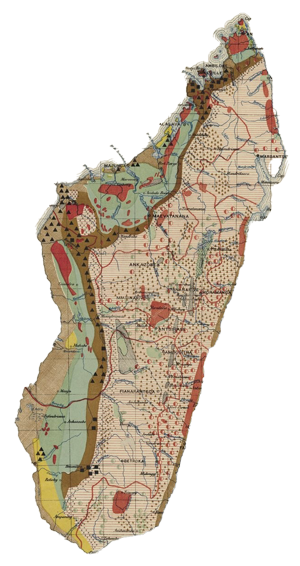
Finally, in other cases, such as the nationalization of banks in Madagascar, the confrontation between the Bank and a post-colonial government was considerably more direct and resulted in a forced withdrawal. In the mid-1970s, the BPPB remained the island’s leading private banking operator, through the Banque de Madagascar et des Comores, the Banque pour le commerce et l’industrie de Madagascar, a subsidiary of the BNCI, and a substantial holding in the Banque malgache d’escompte et de crédit. Following the abrupt nationalization enacted on 16 June 1975, extremely tense negotiations began, mediated by French diplomacy and international organizations, while “the total compensation requirements exceed[ed] the capacity of Malagasy assets”.9
Faced with the low levels of compensation proposed by Didier Ratsiraka’s socialist government, the BPPP decided to suspend guarantees on documentary credits, “required by the exporters supplying the Big Island”, a dependency directly inherited from the colonial era. In various memoranda, advisers at the Embassy expressed fears of “draconian restrictions” and “stock shortages” affecting essential goods, prompting the government to establish new relationships with US banks (Chase and First National), as well as Algerian and Romanian banks.10
Compensation was eventually agreed four years later. It was deemed “fair”, although the amounts involved were proportionally much higher than in other expropriation cases. In Madagascar, poor political relations together with weak development prospects led the Bank to adopt a tougher position, preferring to make way for international competitors in order to maximize compensation for its asset losses.11
A new economic geography
Viewed through the BPPB archives, independence thus appears less as a moment of rupture than as a period of reconfiguration, characterised by a diversity of national trajectories ranging from negotiated transitions to more direct confrontations. While the Bank naturally sought to limit its short-term capital losses, the frame of reference had changed profoundly by the beginning of the 1970s.
The horizon was no longer that of the former empires: it was becoming that of a more financialised global economy, in which risk management — including political risk — gradually took precedence over earlier territorial logics. Within this framework, the model of subsidiaries specialising in “overseas” activities gave way to a centralised approach, contributing to the banking concentration characteristic of the period.
Depending on the sectors, companies and countries concerned, some holdings were retained — though never at any cost — while others were reorganised or abandoned. All formed part of a redefinition of formerly colonial activities within national economies working towards sovereignty and turning towards new areas of consumption.
The opinions, viewpoints or statements expressed in this content are the sole responsibility of their authors.