23 May 2000: the BNP Paribas Group is born

BNP Paribas has a long history going back 200 years, but the current structure of the Group originated on 23 May 2000, when the BNP General Meeting approved the merger between BNP and Paribas to form the BNP Paribas Group. In doing so, it ended an unprecedented stock market battle in the financial sector and paved the way for a great industrial adventure. A look back at this landmark episode in European banking history.
A necessary merger and an epic stock market battle
Bombshell in the financial world on 9 March 1999 as BNP launches a dual public exchange offer for Société Générale and Paribas. It is an ambitious, unprecedented offer, especially in the French context. What led BNP to take this daring initiative and make financial history?
Since the end of the 1980s and with the prospect of the single European market in 1993, which began with the free movement of capital from 1990, the European banking world had been taken by major strategic thinking and manoeuvres: establishments had to become large enough to make the investments necessary to offer extended services to their customers and face their competitors. The last decade of the twentieth century therefore saw the mergers of UBS and SBS in Switzerland, the acquisition of Midland Bank and CCF by HSBC and the purchase of TSB by Lloyds Bank in the United Kingdom and the merger of Banco Santander and Banco Central Hispanoamericano in Spain. Italy and Germany were still behind.
And in France? Banks got to work with varying degrees of success: Crédit Lyonnais’ costly acquisition strategy turned against the bank in 1992; Crédit Agricole, whose regional banks merged at a sustained pace, took over Indosuez in 1996 and then Sofinco, a pioneer in consumer credit. As for BNP, since its privatisation in 1993, its chairman Michel Pébereau had attempted several friendly mergers that had not come to fruition. At the beginning of 1999, BNP’s senior management was in talks with Société Générale to merge the two establishments. But on 1 February 1999, to everyone’s surprise, Société Générale announced it planned to merge with investment bank Paribas, effectively pushing BNP to the side.
Michel Pébereau and his staff then proposed a bold counter-attack to their board of directors.
The battle on the stock market and the media
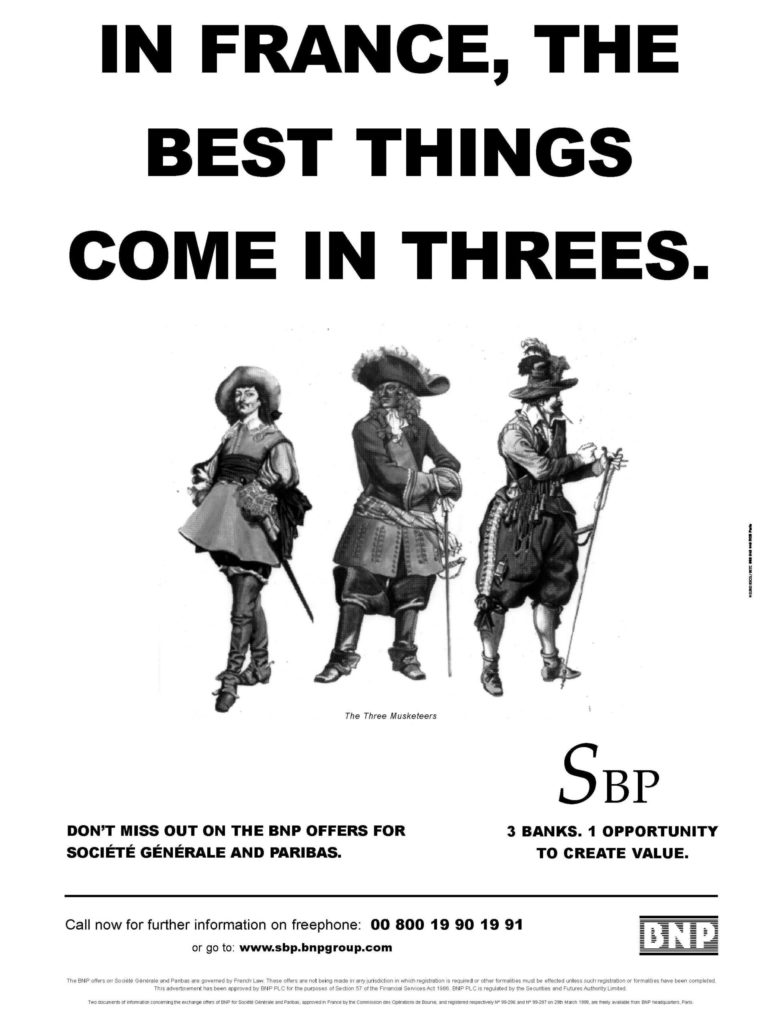
BNP’s offer, a three-way merger – BNP, Société Générale and Paribas – was technically a double public offer to exchange BNP shares for Société Générale shares and Paribas shares. It received the approval of the board of directors and the support of Axa, one of BNP’s major shareholders. The project, which was called SBP (the initials of the three components), was daring but was better received by the market than the competing project, in particular because of the increased profitability of BNP since 1993 and a more reassuring organization. A six-month stock market battle ensued during which the protagonists rallied their supporters and launched competing media blitzes to convince investors, in France and abroad.
After increases in reciprocal offers, BNP had the upper hand at the end of August 1999, as it controlled 31.8% of the voting rights of Société Générale and 65.2% of Paribas’. While many members of Paribas’ management were in favour of the SBP project, which provided for their equal treatment, the efforts by Société Générale’s staff against this project had the supervisory authorities fearing there was an operational risk element to the merger. After a failed attempt to reach a compromise under the aegis of the Governor of the Banque de France, the authorities ended up considering that the offer did not give BNP “clear control” over Société Générale and, on August 27, forbid it from taking possession of the securities brought by the market. On the other hand, the massive vote of investors for control of Paribas made it possible to create the BNP Paribas Group.

The creation of the BNP Paribas Group
6 days, 6 weeks, 6 months
As soon as the results of the offers was known at the end of August 1999, it was a question of merging the two banks, BNP and Paribas, with a different history and very dissimilar cultures. While maintaining the two names showed respect for their traditions anchored in 150 years of history, the idea was to present to employees a new project carried by values and objectives different from those which had driven the two banks until then.
All efforts were made to ensure a successful integration within a very short timeframe. It took six days to set up a new executive committee which included, based on a principle of equity, an equivalent number of BNP and Paribas managers. It then took six weeks to form working groups on the merger, and finally six months to implement the new organisation. On 23 May 2000, BNP’s General Meeting ratified the merger. With this decision, BNP Paribas became the third-largest European bank by equity and net income.
A new logo (“taking flight”) was unveiled at Roland-Garros in May 2000 to symbolise this new European project.

An integrated and balanced Group

Although the European vision that guided BNP in the 1990s had not fundamentally changed, the new BNP Paribas Group in 2000 had a structure that was quite different from that of its separate components. It was based on three main areas:
- Corporate and Investment Banking,
- Private Banking, Asset Management, Securities Services and Insurance,
- Retail Banking,
The resulting whole made it possible to build a diversified, balanced and integrated model which was to guarantee both profitability and resilience. Building on the experience of this successful merger, BNP Paribas was able to integrate Turkish bank TEB in 2005, Italian bank BNL, the bank for Italian cinema for over 80 years in 2006 and Belgian bank Fortis in 2009. The resilience of the model allowed the Group to get through the 2007–2009 crisis without a deficit.
Between 1999 and 2019 the number of Group employees worldwide went from 77,000 to 198,000, and net income from €3.26 billion to €8.17 billion. The Group also moved forward with its digital transformation, starting a powerful and inexorable evolution towards a model with a positive environmental and social impact.