BNP Paribas and the Financing of Shopping Centres
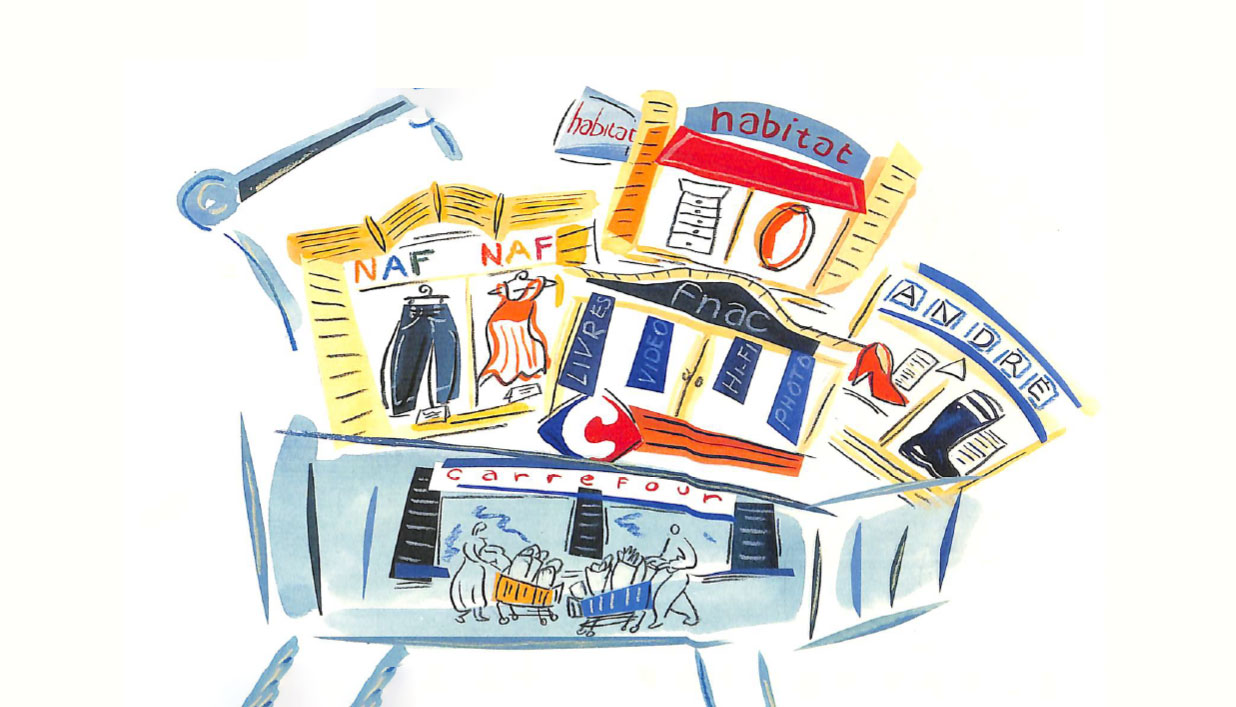
1948. France is rebuilding—and with it, a new way of consuming emerges. The rise of self-service shopping and stores redesigned for everyday life, combined with the growing workforce participation of women, is transforming purchasing habits. Gone are the countertop transactions—replaced by open shelves, shopping trolleys, and an unprecedented sense of freedom for customers whose purchasing power is on the rise. But beyond this revolution lies an even deeper shift: the dawn of the modern retail era.
Banks are closely monitoring these developments and supporting them, just as they contribute to the growth of consumer credit—which, like the new “cathedrals of modern commerce” described by Zola in Au Bonheur des Dames, is revolutionizing access to new consumer goods.
Paribas: A Pioneer in Financing Innovation
In the aftermath of World War II, Banque de Paris et des Pays-Bas (Paribas) expanded its investments into new territories and some of the economy’s most innovative sectors.
This is reflected in the words of Jean Reyre, who became Managing Director of Paribas in 1948.
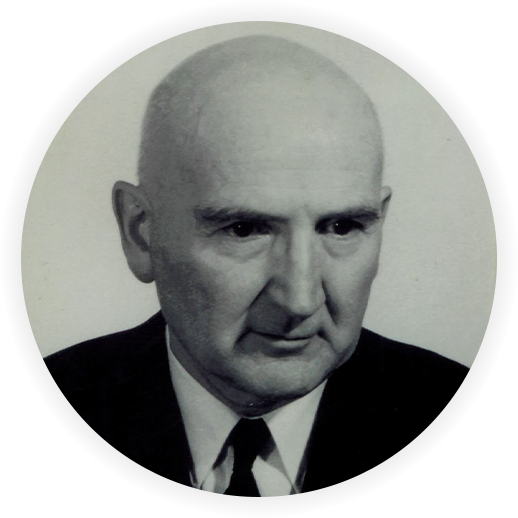
“An investment banker must be a merchant with a creative imagination.”
Through its real estate division, the bank financed the reconstruction of city centers—such as Tours in the mid-1960s—as well as infrastructure and commercial hubs.
These financing operations took diverse forms. The bank provided funding to companies responsible for urban development, as was the case in Dijon, where it supported the mixed-economy development agency for the Dijon metropolitan area, including the ZAC (joint development zone) and shopping center project.
In some large-scale initiatives, the bank played a more direct role, contributing to major commercial centers like those in Évry and Vélizy 2.
Expanding Commercial Offerings in the Outer Paris Region: The Case of Évry
The Évry shopping center project was part of the French government’s broader territorial planning policy. Various organizations were established to support this goal, including the Direction pour l’Aménagement du Territoire (DATAR, the Directorate for Territorial Planning), created in 1954, as well as regional bodies such as the Institut d’Aménagement et d’Urbanisme de la Région Île-de-France (IAU îdF, the Paris Region Urban Planning and Development Institute).
New local authorities were also formed in this context, particularly following the law of July 10, 1964, which restructured the former Seine-et-Oise department into three new departments: Val-d’Oise, Yvelines, and Essonne. Évry was designated as the administrative capital of Essonne and officially became Évry-Ville Nouvelle (Évry New Town).
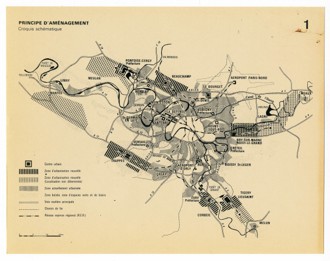
Évry before 1965
In 1964, Évry-Petit-Bourg was a village surrounded by fields—remote yet strategically located at the crossroads of waterways, railways, and highways. These routes provided easy access to the south, north, neighboring departments, and the municipality boasted vast plots of land ripe for urban development.
Read also:
Naissance d’une “ville nouvelle” (in French only)
In 1975, the Évry 2 regional shopping center was established.1
The development of the Île-de-France region saw the creation of other new towns, including Cergy-Pontoise, Marne-la-Vallée, Saint-Quentin-en-Yvelines, and Melun-Sénart. The municipality of Évry was positioned at the epicenter of development in southern Paris. Consequently, in 1969, the public development agency for the town was established. New neighborhoods, complete with housing and amenities, began to emerge.
(Photo: Excerpt from a promotional brochure for the Évry 2 shopping center, BPPB Immo/36, BNP Paribas Historical Archives)
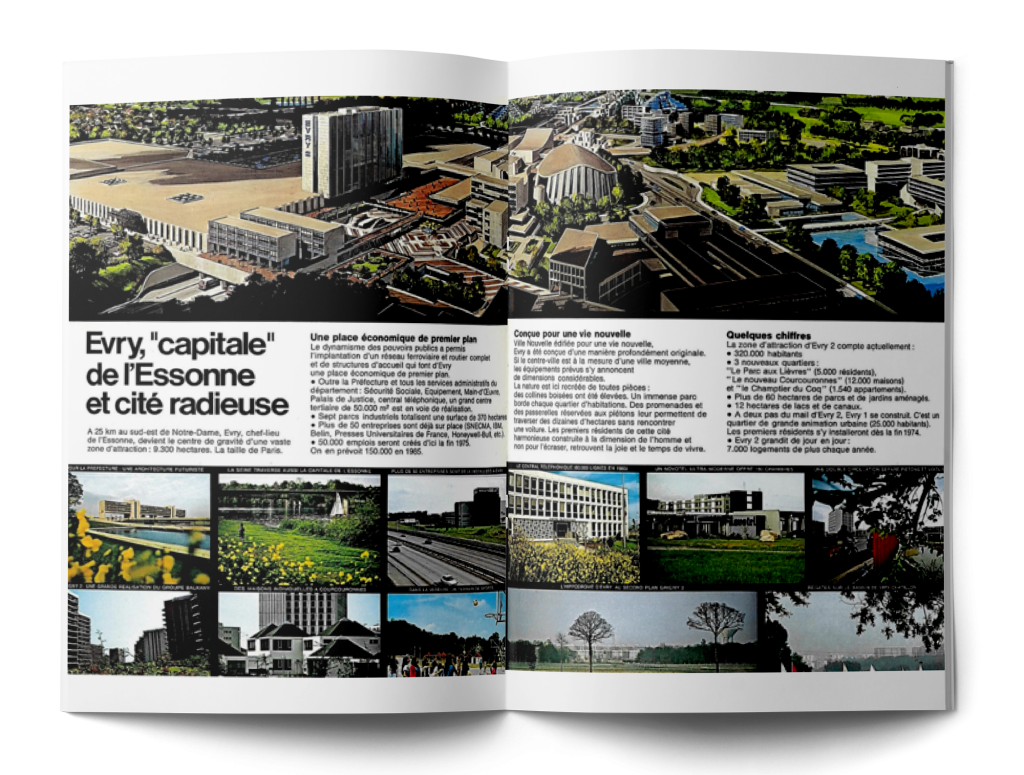
Following the public tender launched by the Évry Public Development Agency for the construction of the shopping center, the contract was awarded to Coredis—a subsidiary of Banque de Paris et des Pays-Bas (Paribas) specializing in shopping center development. The project was ambitious in scope, spanning 78,000 m² and featuring two department stores, a supermarket, and numerous retail brands.
Strategically located near the préfecture (regional government headquarters) and the Agora complex—a cluster of public facilities—the center formed part of a **”cohesive, fully integrated development of over 100,000 m² of covered, climate-controlled space.”2. Financing for the project was equally split, with 50% provided by Banque de Paris et des Pays-Bas and 50% by Crédit Lyonnais.
Adapting to Major Economic Shifts: The Example of Printemps Nation
Banks closely monitor the evolution of well-established commercial formats within society, particularly department stores. As long-standing shareholders of these institutions—many of which originated in the mid-19th century—they support their transformations throughout the second half of the 20th century.
The case of Printemps exemplifies these changes. In the early 1960s, department stores adapted to the evolving needs of customers, who were increasingly frequenting supermarkets and hypermarkets. Major department store chains began expanding into large regional shopping centers. Notable examples include Galeries Lafayette at Belle-Epine in 1971 and Printemps at Vélizy 2 in 1972.

The “Au Printemps” department stores also introduced an innovative project: Printemps-Nation. Inaugurated on the Cours de Vincennes in 1964, this new store exemplified the evolving retail landscape. Unlike traditional locations in central Paris, it was strategically positioned at the edge of the capital. The store featured specialized departments consistent with classic department stores, along with a vast basement dedicated to food—offering fresh produce, canned goods, and a butcher section. The venture proved highly successful, as noted by Paribas executives, who observed that *”on certain test days, sales exceeded twice the projected figures.”3.
The success was such that the subsidiary created for this project eventually absorbed Uniprintemps, the holding company overseeing all provincial Printemps stores. Building on this experience, expansion into shopping centers represented both a continuation of this evolution and a response to the crisis affecting Parisian department stores in the late 1960s. An internal bank memo highlighted the “demographic growth of the suburbs and the proliferation of shopping centers in these areas, which increasingly competed with Parisian department stores.” 4
This led to the closure of the Printemps store in Versailles in the early 1970s, as the focus shifted to the new Parly 2 location, which opened around the same time.
(Opening of Parly 2 in Le Chesnay, 1969 – Excerpt from the video “History of Shopping Centers,” BNP Paribas Group Historical Archives)
Printemps underwent reorganization, as its long-standing leaders—Pierre Laguionie and his son-in-law, Jean Vigneras—stepped aside, making way for new shareholders. This shift included the Maus Group’s entry into the company’s capital.
The Compagnie Bancaire: Serving Real Estate Development
Founded in 1959, the Compagnie Bancaire was a structure that consolidated a group of companies specializing in targeted financing. In the context of the rising popularity of shopping centers, its leadership turned its attention to financing such projects, establishing specialized subsidiaries for this purpose.
One of these subsidiaries, Ségécé (Société d’Étude et de Gestion des Centres d’Équipement – Study and Management Company for Commercial Centers), was dedicated to commercial urban development. As noted in the 1960 Annual Report of the Compagnie Bancaire, Ségécé had already achieved “notable successes in commercial urban planning by designing and constructing shopping centers within large residential complexes, particularly in Rueil and Rouen.”
Originally created in the early 1950s and initially affiliated with the Union de Crédit pour le Bâtiment (Building Credit Union)5, Ségécé focused on financing commercial real estate projects. Its first venture, launched in 1959, was a 9,000 m² shopping center in Rueil-Malmaison. In 1960, Ségécé oversaw the development of the Val Grieu shopping center in Rouen.
Listen to the podcast:
Throughout the 1960s and 1970s, Ségécé expanded its portfolio significantly, including: the new town of Créteil, Belle-Épine (1971), spanning 100,000 m² of retail space, three new projects in Rouen (1973), Créteil Soleil (1974), Nantes Baulieu (1975), Marseille Bourse (1977), Clermont-Ferrand (1980).
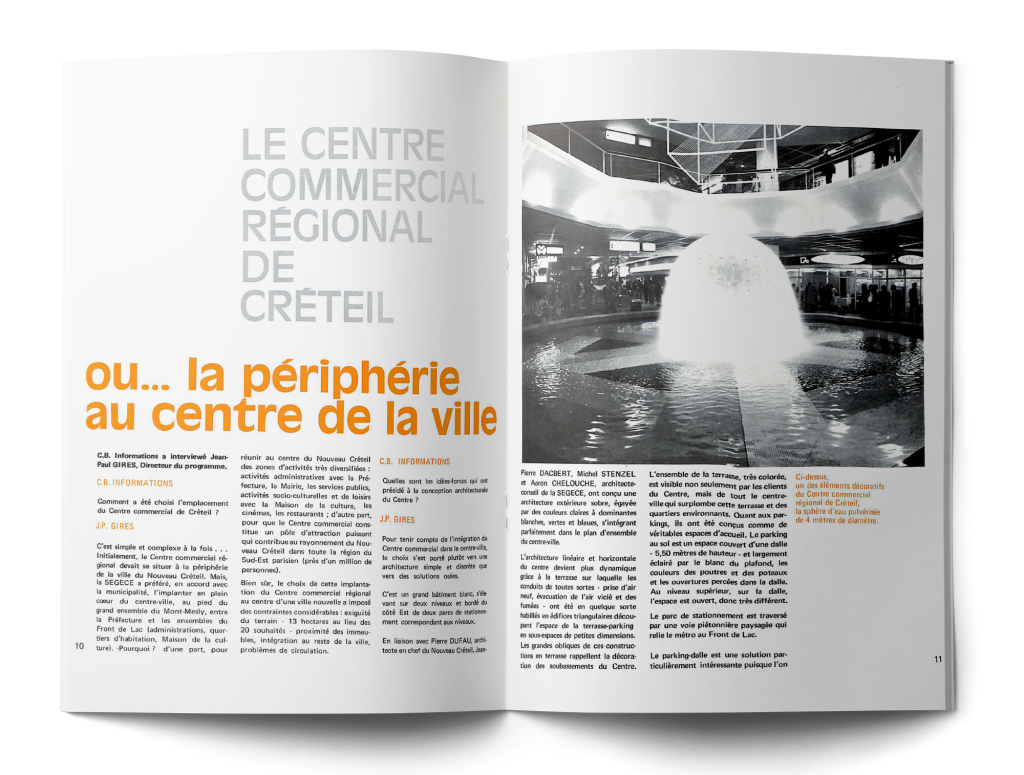
To oversee all its real estate activities, the Compagnie Bancaire established the SINVIM (Société d’Investissements Immobiliers de France) in 1961, to which Ségécé was then affiliated. SINVIM’s mission was to “develop new forms of support for real estate development aimed at both facilitating the work of traditional developers (without replacing them) and ensuring maximum security for homebuyers.” Numerous projects followed, with both companies spearheading the development of shopping centers in Évreux, Laval, and Saint-Étienne in 1964.
Paribas’ increasing stake further strengthened the influence of these two entities.
In the early 1990s, the parent company—majority shareholder of the Compagnie Bancaire—placed Cogedim (its real estate development subsidiary) and SINVIM under joint leadership, while Ségécé remained a subsidiary of the latter. Concurrently, another Compagnie Bancaire subsidiary, Klépierre, succeeded Locabail Immobilier—founded in 1968 by the Compagnie Bancaire—and absorbed the various real estate and commercial development subsidiaries of both the Compagnie Bancaire and Paribas. This restructuring was largely driven by the 1991 legislative changes affecting Sociétés Immobilières pour le Commerce et l’Industrie (SICOMIs), leading Klépierre’s leadership to abandon its SICOMI status.
The consolidation of real estate activities continued after the BNP-Paribas merger, which progressively refocused its operations in the 2000s and 2010s, culminating in the sale of the majority of its stake in Klépierre in 2012.
Shopping Centers: An Economic Opportunity for BNP
BNP also closely followed the rise of shopping centers, taking stakes in various financing entities—including the Immobilière du Centre Commercial Bourse-Marseille.
Shopping centers represented a significant economic opportunity due to their high foot traffic, prompting banks—BNP in particular—to open numerous branches within them.
As early as 1968, the bank established a permanent office in the Mammouth hypermarket in Barberey-Saint-Sulpice, a suburb of Troyes. This was one of the very first Mammouth hypermarkets (a brand launched in 1968 and later acquired by Auchan in 1996), allowing BNP to secure modern premises in a high-traffic location.
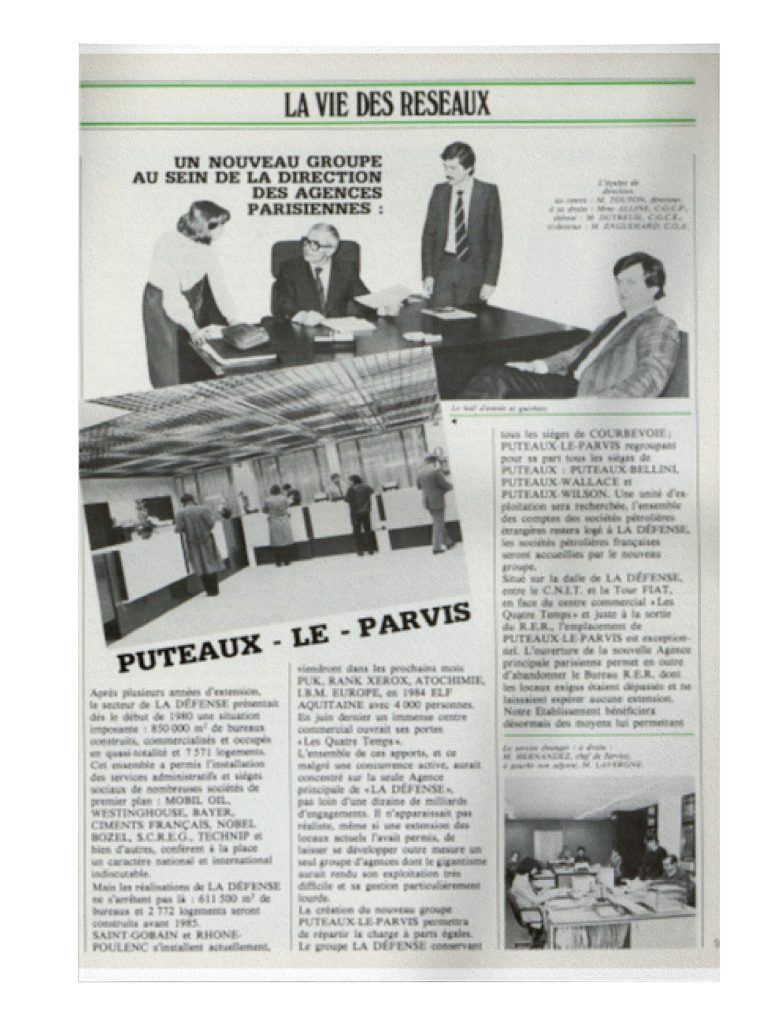
The bank further expanded its presence in the Paris region with the opening of the Quatre Temps shopping center in La Défense in 1981.
The location of the new Puteaux-Parvis branch, situated on La Défense’s esplanade—“between the CNIT and the FIAT Tower, opposite the ‘Quatre Temps’ shopping center and right at the RER exit”—was described as “exceptional”.
This strategic positioning enabled BNP to allocate the necessary resources to meet the growing needs of both corporate and individual clients in the business district and shopping center.
The financing, construction, and operation of shopping centers represent a key aspect of banking activity, closely tied to the rise of consumer goods and the adoption of American-inspired sales methods that spread across Europe after World War II.
The rise of online shopping marks a new era for shopping centers, which can no longer guarantee high foot traffic. As a result, retailers are turning to new ways of engaging their customers.


Did you enjoy this story ?
This selection of articles might also interest you!