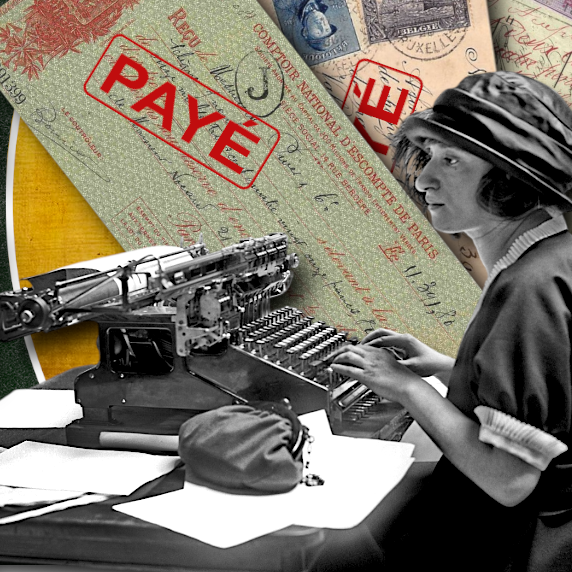
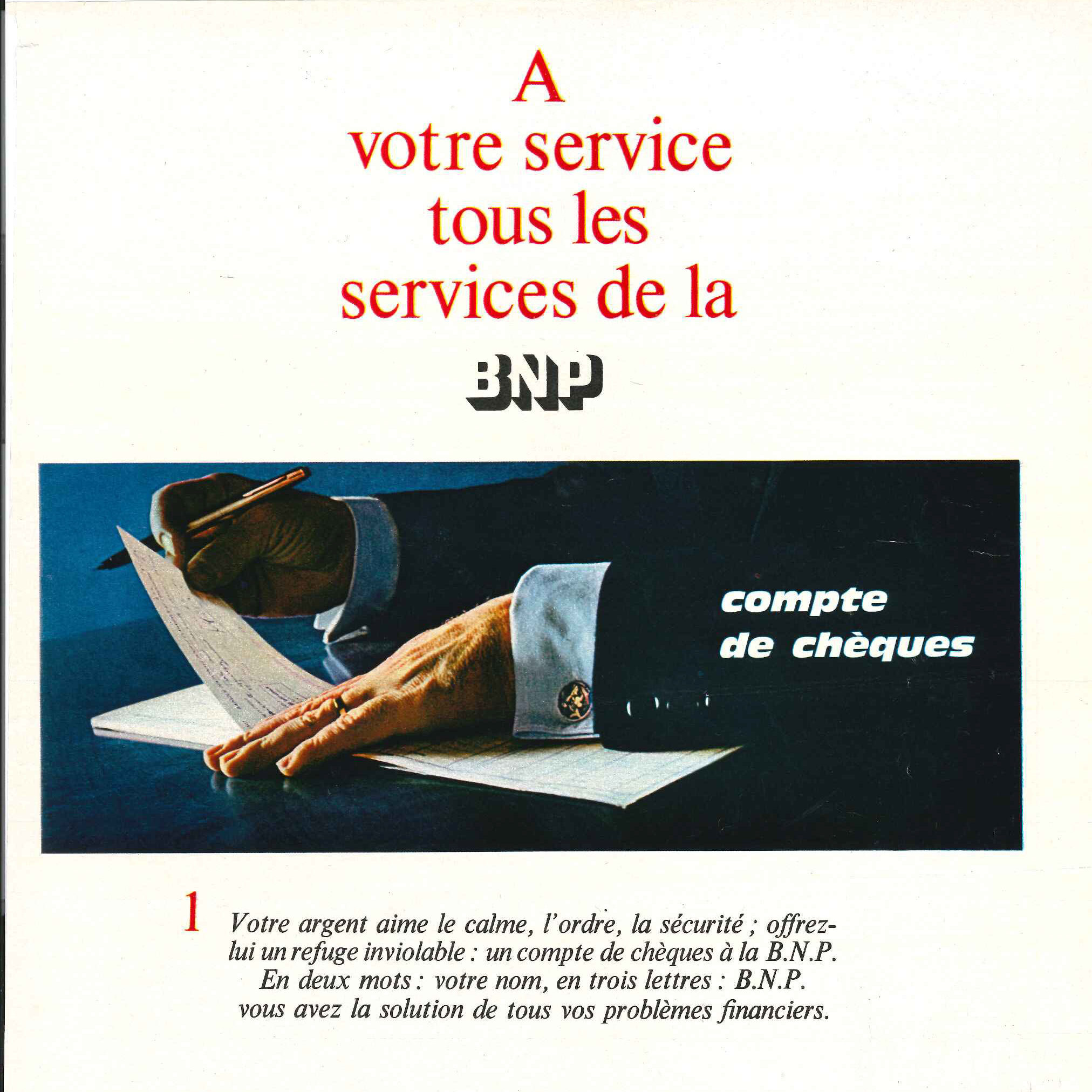
Travel Safely with Traveller’s Checks!
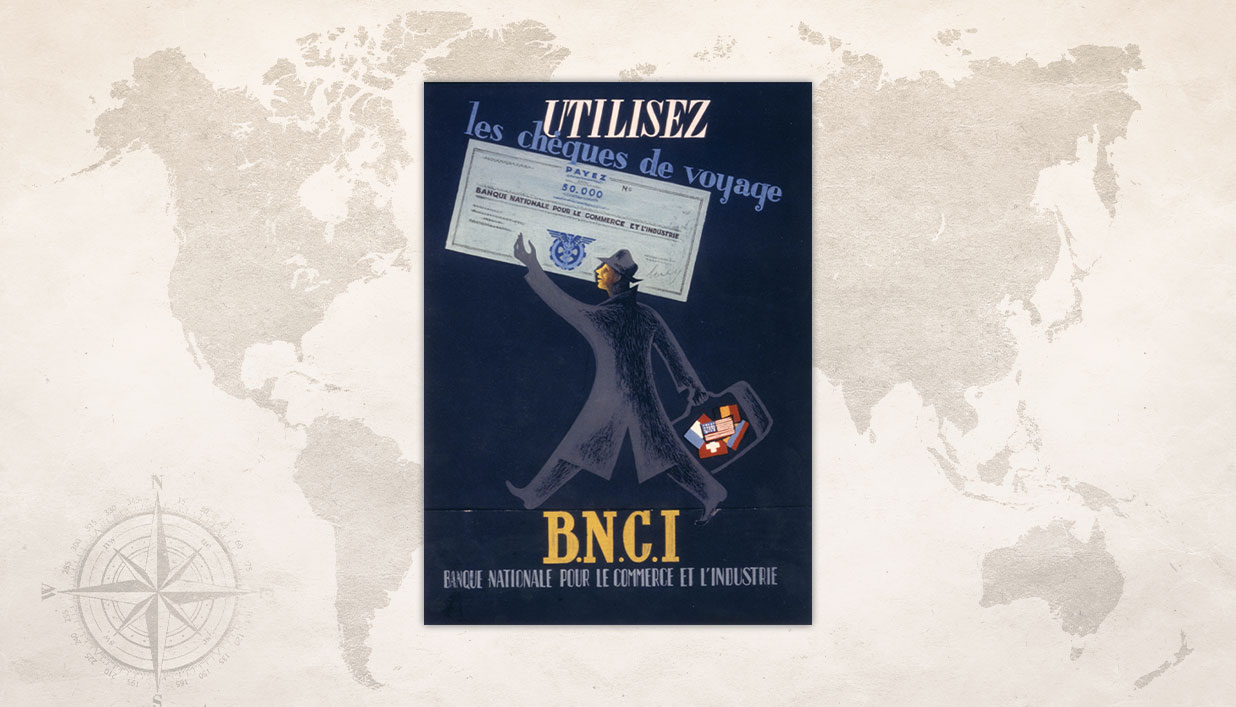
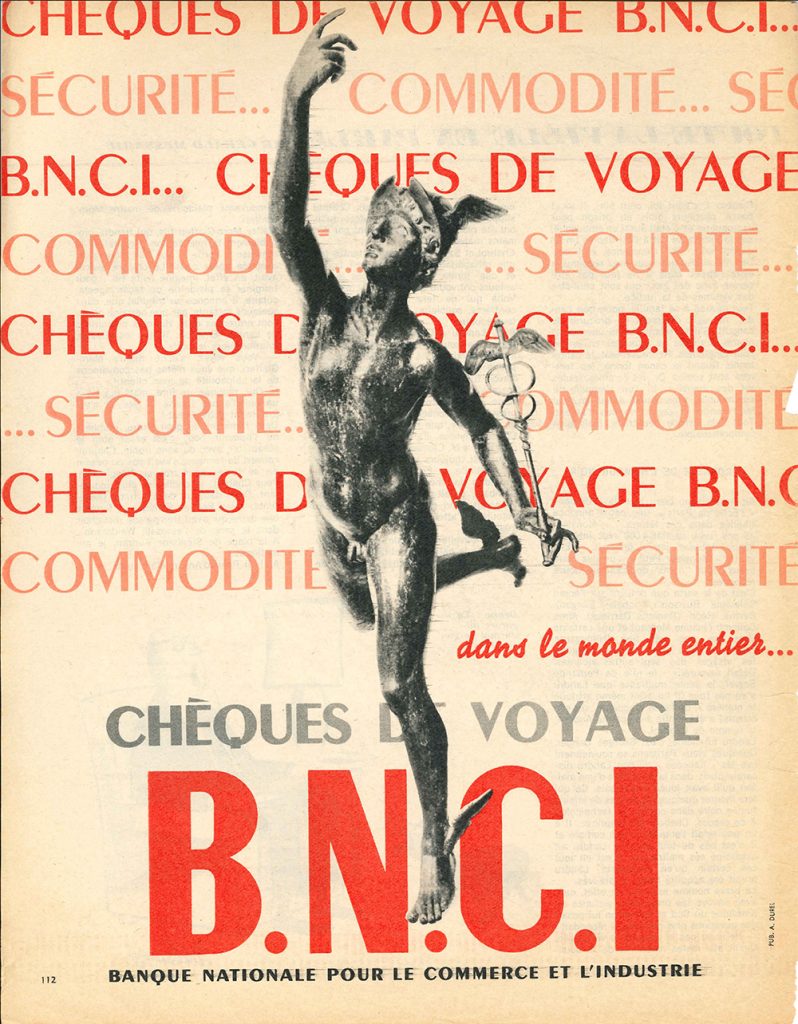
On this poster, a man in a felt hat and long overcoat strides forward, a suitcase in hand. But what’s inside? Certainly not stacks of cash. With traveller’s checks, this “gentleman farer” could settle his hotel bills in New York, London, Brussels, or Zurich without carrying large sums of money. A guarantee of safety in an era before bank cards existed!
After World War II, as living standards steadily improved and the French became more familiar with modern payment and savings methods, banks had to consider the needs and demands of their new clientele: individuals. These customers became the focus of special attention, as they provided the majority of banks’ resources from the late 1950s onward. This is why the Banque Nationale pour le Commerce et l’Industrie (BNCI) introduced traveller’s checks for them during this period.
A traveller’s check was a fixed-amount payment instrument with no expiration date and no age restrictions, allowing the holder to pay for expenses abroad—even in places where they were completely unknown. Each check bore a unique serial number.
For the holder, identification procedures were greatly simplified. Traveller’s checks ensured safe travel without the need to carry large sums of cash. Additionally, they could be reimbursed in case of theft.
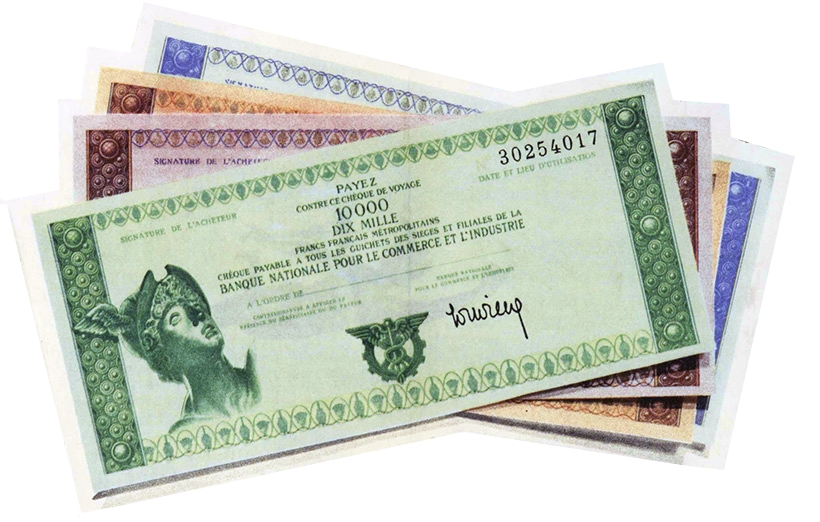
Colorful Checks
BNCI’s traveller’s checks came in different denominations, each in one of four colors: green, mauve, salmon, and blue.
As stated in BNCI’s April 1965 circular:
“Due to the sensitivity of the inks used, avoid handling the forms with damp fingers. The use of a finger cot for handling or counting these forms is recommended.”
Traveller’s checks were definitively phased out in 2013, as their functions are now largely covered by bank cards.


Did you enjoy this story ?
This selection of articles might also interest you!