BNP Paribas’ predecessor Banks in the Rebuilding of the International Order (1945-1950)
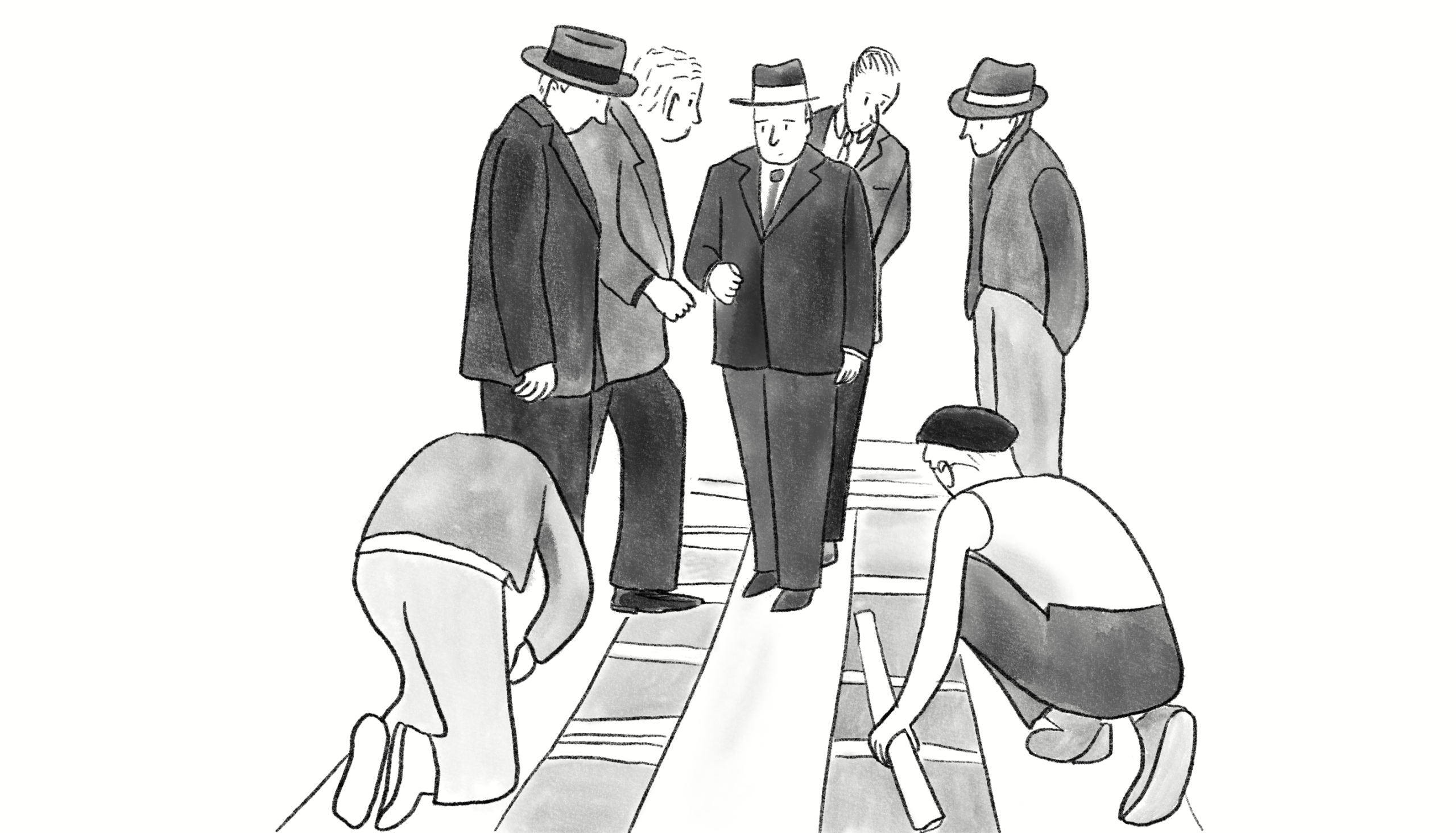
From the end of World War II to the early 1950s, a new international order was established: the creation of the United Nations, the Bretton Woods agreements, followed by the launch of the Marshall Plan. Its ambition was clear: to ensure peace, restore monetary stability, reopen trade, and provide Europe with the material means for its recovery. BNP Paribas’ predecessor banks closely followed these transformations and directly participated in restarting payments, credit, and investment. The archives they left behind allow us to track their analyses and operational implementations.
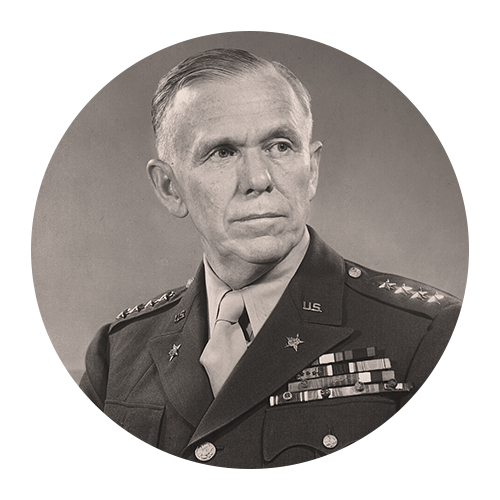
« The remedy lies in breaking the vicious circle and restoring the confidence of the European people in the economic future of their own countries and of Europe as a whole. »
— George C. Marshall, Harvard speech, June 5, 1947
A New International Order Takes Shape
Europe emerged from World War II in ruins. It had to rebuild but also regain a framework of political, monetary, and economic stability. In other words, it was not just about reconstruction but about establishing a new international order.
The first step in this reconstruction was political.
The creation of the United Nations (UN) in 1945 responded to a lesson learned from the first half of the 20th century: peace could no longer rely solely on traditional diplomatic balances. The failure of the League of Nations, the violence of the war, and the scale of destruction necessitated the establishment of a new political framework. Signed in San Francisco on June 26, 1945, and entering into force on October 24 of the same year, the UN Charter set this ambition: to maintain peace, promote cooperation between states, and organize a more stable international order.
But lasting peace could not be separated from economic stability.

Bretton Woods: Without a Stable Currency, No Sustainable Reconstruction
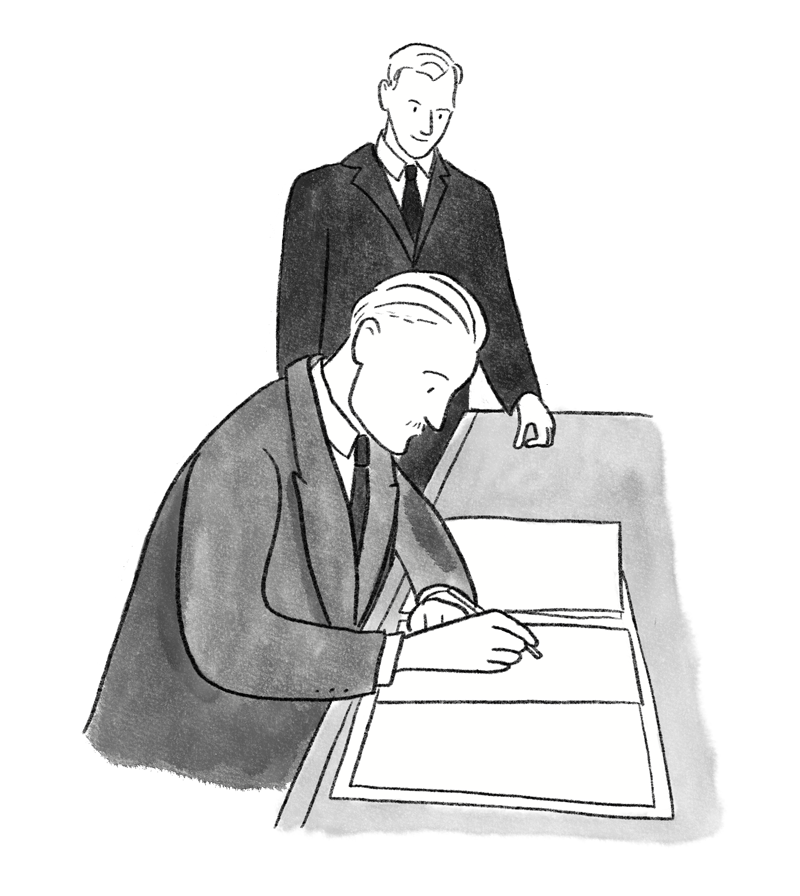
Even before the end of the conflict, the Allies sought to avoid a return to the monetary and trade disorders of the 1930s. In July 1944, forty-four countries met in Bretton Woods, USA, to lay the foundations for a new international monetary system. The agreements established fixed but adjustable exchange rates between currencies, pegged to the US dollar, which was itself convertible into gold.
Two major institutions emerged from this conference: the International Monetary Fund (IMF) and the International Bank for Reconstruction and Development (IBRD), the future World Bank. The goal was to prevent competitive devaluations, restore confidence, and promote the resumption of trade.
In 1946, Banque de Paris et des Pays-Bas closely followed this reconfiguration: « The stabilization of exchange rates appears as a prerequisite for the normal resumption of trade. Monetary uncertainty remains one of the main obstacles to the reestablishment of international economic relations. » (BNP Paribas historical archives, 11AH1217)
Banking circles did not merely record the new monetary situation; they quickly understood its concrete implications for international trade.
Stabilizing currencies was not enough; it was also necessary to facilitate the movement of goods. This was the objective of the General Agreement on Tariffs and Trade (GATT), signed in 1947

The Dollar Gap, or the Reconstruction Deadlock
This new monetary order did not, however, resolve Europe’s immediate difficulties. To restart, deeply disrupted economies needed to import machinery, raw materials, coal, oil, and sometimes even food. But these purchases were made in dollars, and dollars were scarce.
By the late 1940s, the United States held nearly two-thirds of the world’s gold reserves, while European countries suffered from an acute shortage of foreign currency. This shortage, known as the dollar gap, was one of the main obstacles to reconstruction.
A note from Banque de Paris et des Pays-Bas’ Economic Studies in 1946 highlighted its very tangible effects:

« The insufficient availability of hard currencies currently limits the possibilities for importing goods necessary for industrial reconstruction. Companies thus find themselves unable to obtain certain essential equipment needed to restart production»
— Banque de Paris et des Pays-Bas’ Economic Studies, 1946, BNP Paribas Historical Archives, 11AH1217
The monetary constraint translated concretely into industrial blockages, equipment delays, and supply difficulties.
How could Europe rebuild without the dollars needed to pay? This was the contradiction that the Marshall Plan sought to resolve.
A Marshall Plan to Finance Reconstruction

Announced in 1947 and implemented between 1948 and 1952, the Marshall Plan directly addressed the dollar shortage that was hindering Europe’s recovery.
It provided beneficiary countries with the means to import the resources essential for restarting their economies: $13 billion for Western Europe, including nearly $2.7 billion for France. In France, this aid took the form of the Economic Cooperation Agreement signed with the United States on June 28, 1948, for the implementation of the European Recovery Program.
The funds financed priority imports. Their distribution was coordinated at the European level by the Organization for European Economic Co-operation (OEEC), to align national import programs with the needs of industrial reconstruction.
BNP Paribas’ predecessor Banks on the Front Lines
Once payment methods were partially restored, reconstruction took on a more operational form. The flows reflected their priorities.
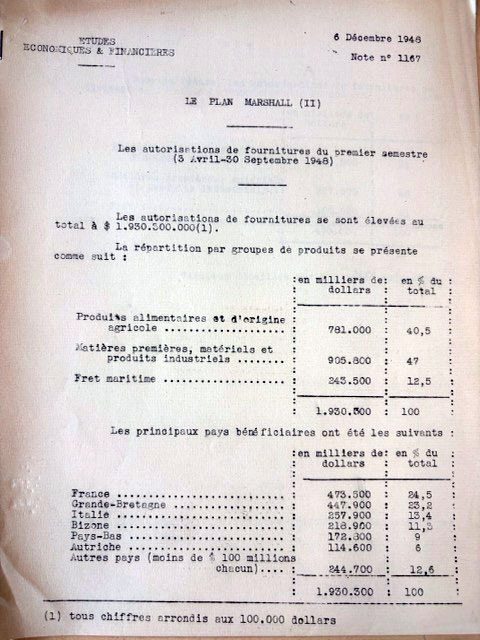
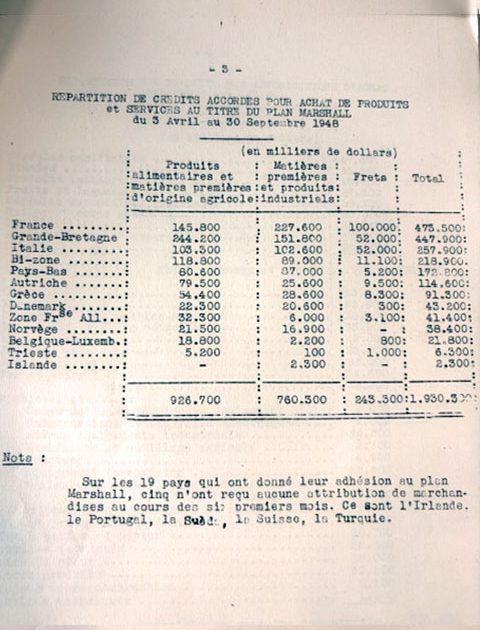
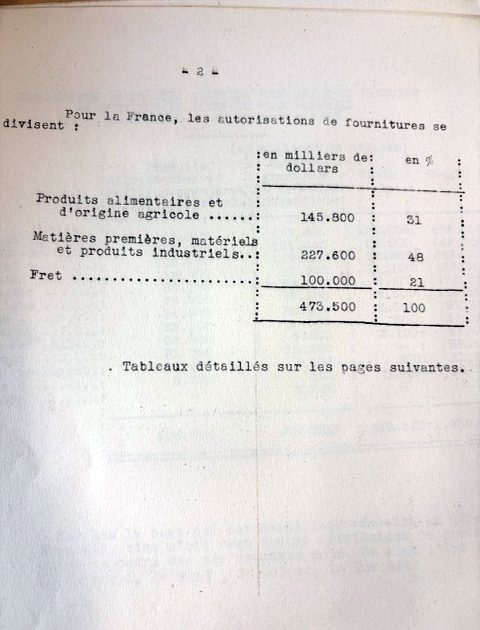
During the first six months of implementation, from April to September 1948, nearly $1.93 billion was committed, primarily for raw materials and industrial products — coal, oil, machine tools, industrial equipment — as well as food supplies. France received approximately $473 million.
-
The Marshall plan, BNP Paribas Historical Archives, 17Cabet54
/
The Marshall plan, BNP Paribas Historical Archives, 17Cabet54
/ -
The Marshall plan, BNP Paribas Historical Archives, 17Cabet54
/
The Marshall plan, BNP Paribas Historical Archives, 17Cabet54
/ -
The Marshall plan, BNP Paribas Historical Archives, 17Cabet54,
/
The Marshall plan, BNP Paribas Historical Archives, 17Cabet54,
/
Banks played a central role in this system. By opening credit lines, securing payments, and implementing financing, they ensured the concrete translation of the aid. Accompanying the Economic Cooperation Agreement, a memorandum regarding the financing of purchases of American equipment recalled that the objective was to « facilitate […] the use of private economic channels. » (BNP Paribas Historical Archives, 12AH1210) The preserved files allow us to track its concrete implementation: purchases of American equipment, prioritization of needs, financial arrangements, and organization of payments.
Reconstruction, therefore, did not depend solely on states or international institutions. It also relied on the actions of financial institutions, which reopened payment channels, mobilized funds, and supported the resumption of investments.
Restoring Payments, Reopening Banking Channels
Intra-European payment mechanisms — balance compensation, drawing rights — were established to revive trade without relying exclusively on the dollar. They thus contributed to structuring a more coherent economic space within Western Europe.
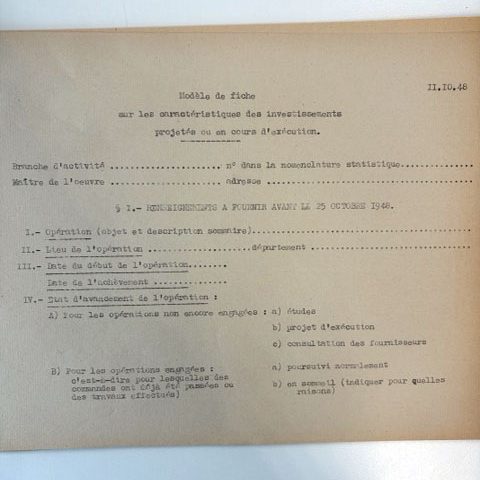
The investment files used by the banks show the concrete implementation of this policy: project monitoring, financing structuring, and anticipation of foreign currency needs.
They allow us to understand reconstruction not only as a diplomatic or financial framework but as a series of operations examined and followed on a case-by-case basis.
-
Financing the purchase of U.S. equipment, Banque de Paris et des Pays-Bas, BNP Paribas Historical Archives, 11AH1210
/
Financing the purchase of U.S. equipment, Banque de Paris et des Pays-Bas, BNP Paribas Historical Archives, 11AH1210
/ -
Financing the purchase of U.S. equipment, Banque de Paris et des Pays-Bas, BNP Paribas Historical Archives, 11AH1210
/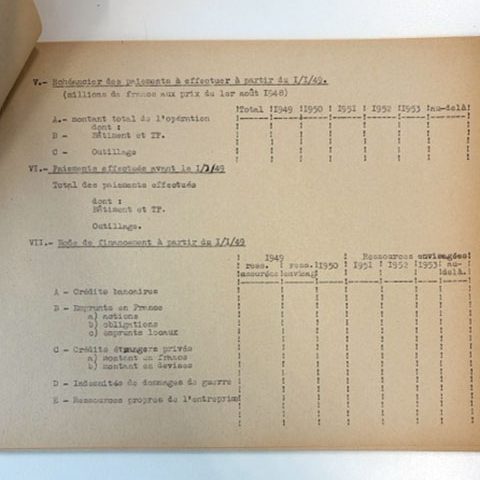
Financing the purchase of U.S. equipment, Banque de Paris et des Pays-Bas, BNP Paribas Historical Archives, 11AH1210
/
This financing was part of a broader economic space. Some of the counterpart value of the aid was mobilized for investments outside the metropole—infrastructure, mining equipment, electrification—particularly in North Africa and overseas territories. The Marshall Plan thus contributed to restructuring not only the European economy but also the economic circuits linked to its sphere of influence.
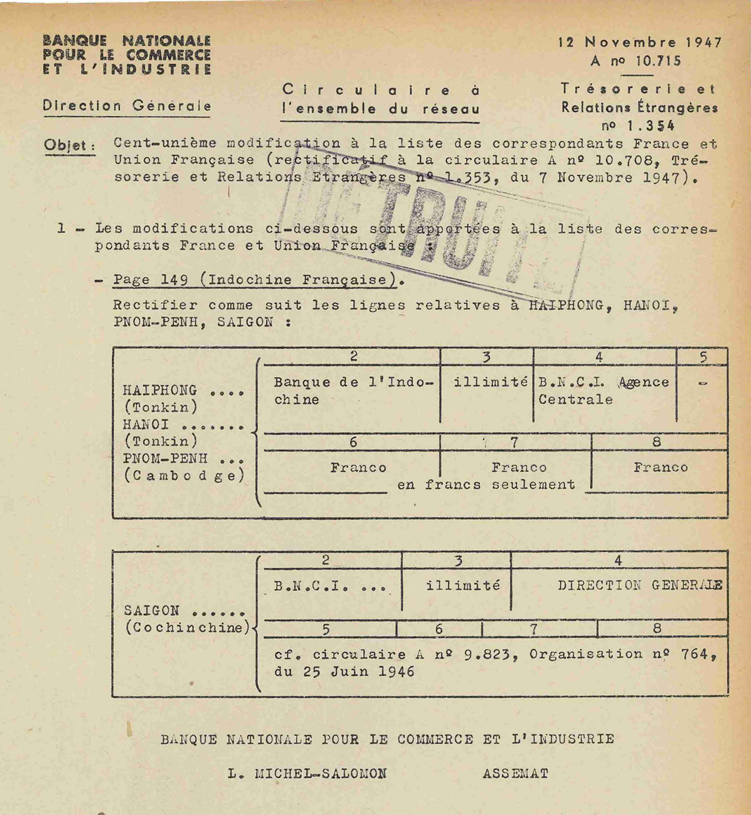
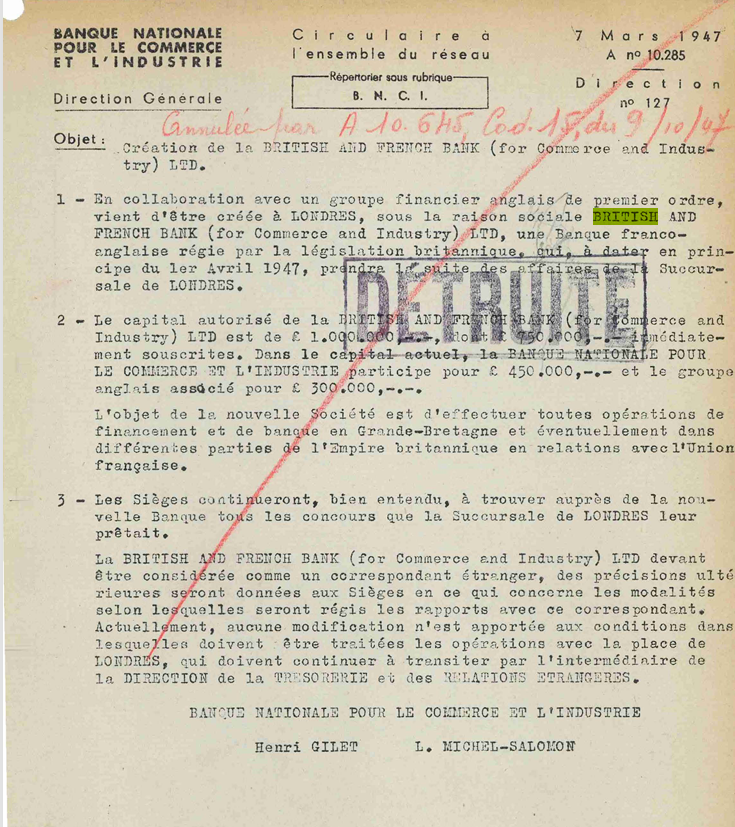
At the same time, BNP Paribas’ predecessor banks worked to restore their international banking networks to revive financial exchanges and support economic and commercial recovery. Banque de Paris et des Pays-Bas renewed ties with its foreign correspondents: London, New York, Brussels, and Geneva once again became essential centers. BNCI circulars allow us to observe the reestablishment of banking links in detail, such as the 101st modification to the list of correspondents in France and the French Union on November 12, 1947. On November 21, 1947, BNCI also extended the rules for processing foreign payment orders with certain authorized correspondents, such as the British and French Bank.
The Marshall Plan thus appeared as a complete system, where international coordination, financial engineering, and banking action were articulated. By organizing capital flows, exchange circuits, and economic solidarities around the United States, it contributed to structuring an integrated Western space. Conversely, it also marked the divide with Eastern European countries, which remained excluded. Economic reconstruction thus became one of the areas where the division of the world into two blocs took place.
A Reconstruction That Redraws the World
At the end of World War II, the challenge was not only to rebuild economies but to recompose the entire international framework, from monetary rules to exchange circuits, from financing mechanisms to banking networks.
But this new order did more than stabilize Western Europe. By structuring around the dollar, American aid, and new cooperation mechanisms, it also redrew the dividing lines that would durably mark the second half of the 20th century.
Further reading:
Bossuat Gérard, L’Europe occidentale à l’heure américaine : le plan Marshall et l’unité européenne, 1945-1952, Paris, Complexe, 1992.
Bussière Éric, Paribas, Europe and the World, 1872-1992, Paris, Fonds Paribas, 1992.
Milward Alan S., The Reconstruction of Western Europe, 1945-51, London, Methuen, 1984.
La France et les institutions de Bretton Woods, 1944-1994, CHEFF, 1998


Did you enjoy this story ?
This selection of articles might also interest you!